Each of us journeys through life, and every story is unique; no two stories are the same as we all travel through time. We may travel some of the same roads, see the same sunset, and feel the ocean summer breeze, but each of us, as individuals, does it in the context of time; we are all time travelers. Time is the only aspect of human existence that is transcendent. We can remember something, someone, a place, a sound, a feeling, but if it is in the past, we cannot go back there, even for a moment; we will never experience that moment again. That mark of our existence transcends space and time.
Along this journey, we have met people and fellow sojourners; some we remember well, and others are gone forever. A person with whom we had a pleasant conversation on a long flight, a classmate who sat next to us in homeroom, or a shipmate from the Navy with whom we shared a barracks. Think, can you name your three best friends in kindergarten? Most could not, and I didn’t remember anyone, yet those classmates were the most important people in my life at that time, especially the teacher.
Now, to the ones we remember, the ones who have marked us, gone but not forgotten. In the past few years, I started compiling a mental list of all the people who are gone, people I truly cared about, who were my friends, family, or maybe just fellow travelers on life’s journey. I compiled a list of everyone who has marked me in life, but here is the caveat: I am only listing those who are gone; their journeys are complete. I am purposely not sharing any lessons from the living; those lessons are still in progress.
Our Origin Story
Each of us has an origin story, where we came from, and who were the people who started us there. Every person begins this journey with a divine flash of light when our father’s seed meets our mother’s fertility. At that moment, life begins, and thus our journey begins, unseen, unknown at that very moment, but to God. But, before long, our journey intertwines with that of our birth mother and our birth father. Those two individuals will either mark us for life with love, nurture, and guidance, or perhaps ignore God’s commandment to parent and go their own way, and use their own wisdom, or lack thereof.
My journey began in a quaint village in upstate New York, just a stop along the Erie Canal in the town of Weedsport. The information I am about to share may seem to be too personal for some, none the less, in 1998, my father and I went on a trip to New York, back to my origins, and he showed me the place, while on a family camping trip in a small cabin, he and my mother created that flash of light, the divine moment, where God makes a human in his image.
Dad was often a silent man, not one who shared many details, but I was thirty-three, and he shared a lot with me on that trip, especially my origins. I will always treasure that week in upstate New York. That week changed how I saw the man, especially the moment when the trip was ending, we had picked up my brother Bobby along the way, and as we were about to depart Schenectady, dad hugged my brother, told him he loved him, and said he was praying for him, then kissed him goodbye on the forehead. Then, suddenly, placing his hand on my brother’s forehead, he prayed a prayer that made it clear, precisely who my dad really was. “The righteous live by faith…”
The Lasting Impression
As we pulled away, I witnessed the alligator tears running down Dad’s cheeks, which continued for hours after we left, driving in silence. Decades later, I know my own alligator tears now, driving away in silence when I say goodbye to my own disabled son after visiting him in another state. The tears and prayers for each of my own three children are different, but the answer to life’s lesson is the same. The lesson learned from my father, the one that was and is the hardest of all, especially when it concerns my children: let go, and let God.
-Al Keller, 1928-2017
Some Wounds Won’t Heal
My mom left some difficult marks on my life. She left when I was eleven, perhaps when a young boy needs his mom the most. When she moved away, she took me with her first. However, like many who walk away from their families, she left the parenting of me up to others; her parenting style was, from then on, the substitute parent.
As a teenager, I ended up moving back and forth between my father’s household and hers, with short stays at each. She had no rules, no boundaries, and neither of my parents gave me much direction in life. Both were substitutionary parents, typical of the Silent Generation. However, in her final years, my mother came to embrace being a grandmother, leaving the past behind, which is why her grave marker reads, “Beloved Grandmother.”
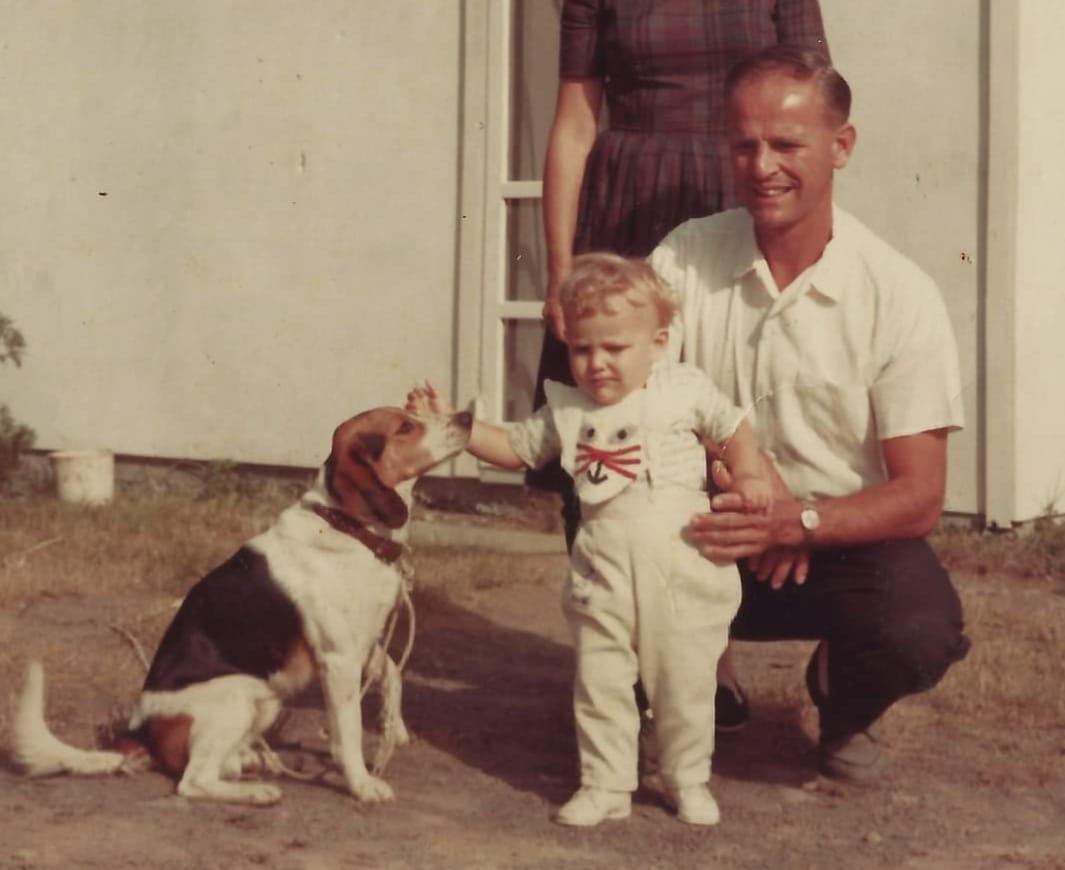
My mother wrote me a beautiful letter for one of my last birthdays prior to her passing away. In that letter, she told me about the day I was born and when she brought me home. It was a well-written, well-thought-out narrative, describing each person who was there when I was born in Auburn Hospital. She even described the weather; it was the blizzard of ’65. In the letter, she shared insight into the joy and wonder of my older siblings, whom I have always looked up to, when she introduced me to them as a newborn. Bobby, the oldest child, stated with a beaming smile, “He’s beautiful.” The picture she created of that scene tells me my origin story, where we began, where I took my first steps, and who the people were who loved me as a baby and as a small child.
While the nurture of my childhood was interrupted when my parents divorced (as all children of divorced parents know), one phrase in her letter to me changed the entire paradigm of how I viewed her. “God has answered all my prayers concerning you…” I treasure those words, the comforting words of a mother to her son. Maybe decades late, but timely nonetheless. The lesson learned: Write the letter.
-Mary Keller, 1932-1999
Bobby
Go sailing, play guitar, and drink root beer while eating peanut butter toast. If you have root beer, peanut butter toast, a decent bicycle, a tent, and some conservation magazines, you have everything you need in life. My brother was a special needs child, but we didn’t call it that back then. To me, thirteen years his junior, he was my hero. He marked my life with four things: A love of sailing, playing guitar, camping, and a cold root beer with peanut butter toast.
Sadly, I only saw him twice after he left Florida in the late 1970s; however, he wrote me often, and I wrote him too. I have only spoken with him on the phone twice since my childhood. I don’t think I ever truly mourned the loss of him leaving me in my teenage years; he left Florida not long after my parents divorced. Bobby was a true nomad; he was hard to track down. Dad and my sister would travel to New York and visit him often. Bobby moved around; there were periods when we didn’t know where he was at all. On his last birthday, my sisters made a plan for us to call him and wish him a happy birthday. What a gift! He answered the phone, and my words to him were, “I love you, Bobby.” his to me were, “I love you too…” The following spring, I turned fifty, he sent me seven dollars, and I wept, because for a person who was disabled, on social security disability, that was a lot of money.
A few months later, I received a phone call on Memorial Day 2015 that Bobby was found deceased in his bed; he had diabetes. My brother was buried with full military honors in New York because he volunteered to join the Navy during Vietnam. All I could think as the Navy presented the folded flag to my oldest sister was that all of Dad’s prayers had been answered. God took care of my brother down to every detail.
Lesson learned: Say “I love you.”
-Robert H. Keller, 1953-2015
Fifth Grade
My fifth-grade teacher passed away mid-school year from a brain tumor during surgery. I had many unanswered questions a fifth grader would never know to ask. Decades later, I randomly found her grave as we had just buried a parent of a friend of mine in the same cemetery. After my friend’s mom’s service, I walked around reading the grave markers. All of a sudden, I found Mrs. Gerace’s grave, and at the exact moment, an older man walked up and replaced the flowers on it. I told him I was a student of hers, mind you, this is over four decades later. Needless to say, he was shocked because he had promised his sister (Mrs. Gerace’s elderly relative) he would stop by and visit the grave on his way to South Florida. That chance moment was a gift, because I was able to ask questions about what happened to her. More importantly, he was able to share with Mrs. Gerace’s family that a student of hers, decades later, had visited her grave and hadn’t forgotten her.
-Mrs. Gerace Remember Them.
Service Related
In 1984, my father promised to take me out to lunch for my nineteenth birthday. He actually kidnapped me for the day, taking me to York Street in Tampa, to the Naval Reserve Center, and, more importantly, to the recruiter’s office. This was just six months after the Marine barracks bombing in Beirut that killed 241 Americans. I now suspect my dad took me to the reserve recruiters because he was concerned for me being drafted into another endless war. Dad was drafted during the Korean War, Bobby, my brother, joined the Navy near the end of Vietnam, even though he was discharged due to a medical condition right out of the end of boot camp. I believe Dad knew; his motive was to keep me from becoming “canon fodder,” as he called it. Years later, I realized this was probably my dad’s motivation for taking me to the reserve recruiters’ office all the way in Tampa.
After completing my initial active service during boot camp and A school, it was almost a year later that I returned home to attend college. However, I loved my job in the Navy. I was a Cryptologic Technician and worked in Signals Intelligence. By the summer of 1986, after volunteering on a few temporary deployments, I realized I wanted to make a career in the Navy. However, leaving the reserves and returning to active duty is not easily accomplished.
Eventually, I contacted Chief Jerry Wilkerson, who was assisting me and helping to process my return to active duty from the Navy reserves. The day finally came: August 14, 1986. After a long day at the MEPS center, I took the oath of enlistment to get back into the Navy full-time. Chief Wilkerson congratulated me and informed me that I would receive my orders very soon. He gave me three choices of duty stations. I stood next to his desk as he wrote them down. I signed some documents and watched him place them in a manila folder on his desk.
As I drove from Tampa back home, I dreamed about the places I might be stationed: maybe a ship, Europe, or perhaps the West Coast. However, when I got home from the MEPS center, I received a phone call from another Petty Officer that Jerry had suddenly collapsed and died from a heart attack right after I left the MEPS center. Unbeknownst to any of us, as a result, Jerry never processed my file. It was most likely in his briefcase. I attended the Funeral in Temple Terrace and the Burial at Bay Pines in my dress uniform, along with many other sailors. It was the saddest day in my memory up until that day. Jerry was a Vietnam Veteran with prior service in the Army. He wore the blue rifle badge on his chest; only a few knew what that badge even was. I asked him once how I could get that, and he smiled, “You can’t.” It was the Army Combat Infantry Badge, awarded only to soldiers assigned to an infantry unit during such time as the unit is engaged in active ground combat. The lesson learned: Death leaves things unprocessed.
-Jerry Alan Wilkerson, 1949-1987
The Crew of Ranger 12
Before Chief Wilkerson’s death, I volunteered for a temporary assigned duty on the USS Nimitz. I was thrilled, as I was finally going to sea, crossing the Atlantic and entering the Mediterranean. This was part of my plan to secure an active-duty assignment. I had a Navy detailor who sent me assignment after assignment of temporary (TAD) assignments. I spent a summer at the Naval Security Group Command in Sabana Seca, visited the NSGA in Homestead several times, participated in Ocean Safari at a secret location in Charleston, and was eager to create opportunities to serve on active duty.
Finally, I arrived in Norfolk, checked into the ship, and was informed by the Officer of the Deck that the Nimitz was not a training ship for reservists; he saw my reserve ID card and was not pleased. However, the chief of our small department rescued me and brought me on board, assigned me my bunk, and showed me the exclusion area where we worked. Combat SESS. A small compartment in the island structure of the carrier. Only a handful of people worked there.
I performed my duties during the air operations, and during downtime, I played chess with one of the pilots assigned to our department’s aircraft. Once my mission was nearly complete, I was offered the opportunity to return to the ship. However, I had to go back to Tampa and be dismissed from my command. At the same time, the rest of the crew flew in from Rota, Spain. I remember how I looked up to them in their flight suits, shaking hands with them all. I remember them; they were linguists and intelligence analysts, fellow cryptologic technicians. One of the linguists spent a considerable amount of time with me; he was very kind and helped me navigate the ship during my temporary assigned duty.
Arriving back in Tampa the next week, I had no idea that they were all killed in a plane crash on the Nimitz. One of the Petty Officers in my unit handed me the Navy Times with the headline “Nimitz Crash Kills Seven…” he asked me if I knew those guys, and I just nodded. I remember feeling numb, in shock, and in disbelief. The crew of seven on Ranger 12 was listed by the Navy as “lost at Sea” on January 25, 1987. I rarely spoke about it, seldom thought about it, until years later when I realized I was experiencing survivor’s guilt. I believe after the combined deaths of the crew of Ranger 12 and Chief Wilderson, there was some conspiracy to keep me from the Navy. I began to spiral, stopped self-care, gained weight, smoked, and became a person with hidden anger.
Lesson learned: Ignored grief takes a toll; it demands payment
-The Crew of Ranger 12, January 25, 1987
There are many more lessons learned from my late friend Lou, my high school crush Wende, my friend Al, Mike, and certainly Paul Kangas, one of the greatest influencers in my life. But for now, I want to reflect on these lessons learned and perhaps continue with the rest as I continue to remember what they meant and what it all means.
What does your list look like?