

The journey of my maternal ancestors is an extraordinary saga of survival, profound faith, and raw fortitude. It spans from the war-torn banks of the Rhine River to the bloody battlefields of the American Revolution, ultimately weaving into the peaceful valleys of upstate New York. This is the story of the bloodlines that shaped your heritage.
The Embers of the Rhineland (The 1600s)
In the late 17th century, the historic cities of Worms and Mannheim along the Rhine River were places of volatile uncertainty. The shadow of the Thirty Years’ War still hung heavy over the Holy Roman Empire, and religious and political persecution was a constant threat.
In Worms, Hans Christoff Johannes (Jost) Emmerich and his wife, Anna Barbara Lindweylers, clung tightly to their faith and family. They could not have known that their son, Johann Ernst Emichen, born in 1654, would one day carry their legacy across a vast, unforgiving Atlantic Ocean. A short journey upriver in Mannheim, a boatman and deckhand named Johannes Schnell navigated the strong currents of the Rhine. He married Barbara Zam in the summer of 1668. Their lives were tied to the river, but history’s currents were shifting. Their son, Jacobus Schnell, born in the autumn of 1674, grew up witnessing a homeland repeatedly ravaged by the armies of Louis XIV. Jacobus married Elizabeth (believed to be Klein), and together they faced the brutal winter of 1708–1709—a freeze so severe that birds froze mid-air and the mighty Rhine turned to solid ice. Driven by famine, cold, and the promise of religious freedom, the breaking point had arrived.
The Great Migration and the New World (1709–1750s)
In 1709, Johann Ernst Emichen joined the massive Palatine migration. Leaving the devastated Rhineland behind, he fled to England before securing passage to the untamed wilderness of the New York colony. He became the foundational patriarch of the family in America, changing the Old World Emmerich/Emichen into a name that would echo through New York history: Empey and Empie. His son, Johannes Empey, born in 1702 in Worms, grew up and married Elizabeth Barbara Snell, born in Mannheim in 1704. Elizabeth was the daughter of Jacobus Schnell and Elizabeth, carrying the brave Snell bloodline across the Atlantic.
The Palatine Settlement: Forging the Frontier
When the first Palatine immigrants arrived in New York, they were initially forced into grueling indentured servitude along the Hudson River, harvesting pine tar for the British Royal Navy. Fed up with broken promises and harsh treatment, a resilient group of these settlers packed their few belongings and pushed westward into the untamed Mohawk Valley.
In 1723, they secured the Stone Arabia Patent. This land was the true frontier—the literal edge of the civilized world. To the north and west lay hundreds of miles of dense, unbroken wilderness controlled by the powerful Haudenosaunee (Iroquois) Confederacy. With unshakeable faith and raw muscle, the Empies and Snells and other families with them went to work felling massive virgin timbers to build rough log cabins and clearing the rocky, stubborn soil to plant wheat, quickly turning the Mohawk Valley into the breadbasket of the colonies. Out of this tamed wilderness, they also erected the iconic Stone Arabia Churches—both Lutheran and Reformed—which stood as the physical and spiritual sanctuaries that anchored their deeply rooted community.
For over fifty years, the Palatine Germans thrived. They spoke their own dialect, maintained their continental traditions, and lived in relative peace. But because they lived on the colony’s geographic border, they also became New York’s frontline defense. When the storm of the Revolutionary War gathered, the Mohawk Valley became a powder keg.
The Red of the American Flag: The Empie Sacrifice at Oriskany
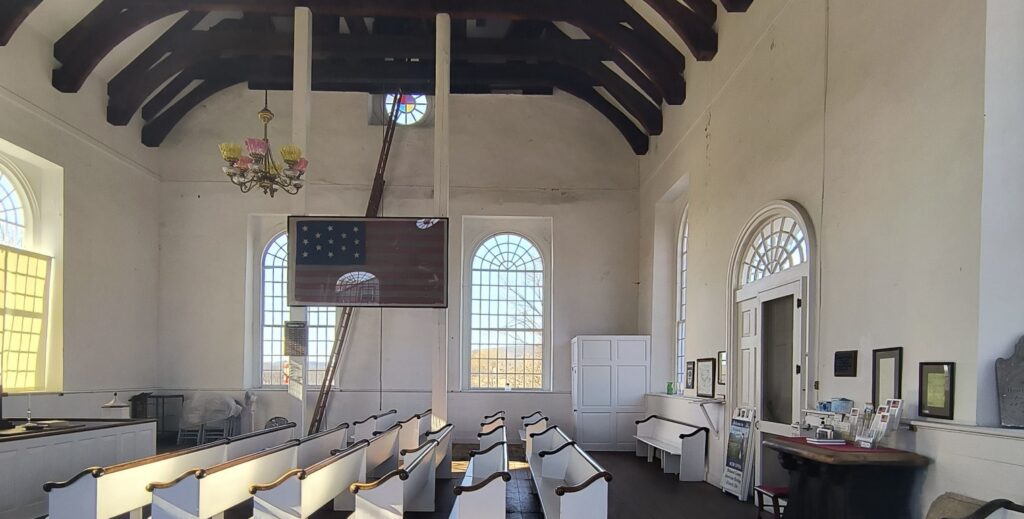
By the onset of the American Revolution, the family was deeply rooted in the soil of Stone Arabia. But freedom required a terrible price.
Johannes and Elizabeth’s son, Johan Jacob Empey (born November 1, 1752), had married Anna Barbara Bayer. By 1777, they had two small sons: John and Jacob.
On August 6, 1777, the fires of war arrived at their doorstep. The British and their allies advanced through the valley, threatening to destroy everything the Palatines had built. Johan Jacob Empey marched out with the Tryon County Militia to stem the tide. His cousin, Frederick Snell, marched alongside him.
They ambushed the enemy in a small, marshy ravine near Fort Stanwix. The resulting Battle of Oriskany was a brutal, close-quarters nightmare fought with muskets, knives, and bare hands in the middle of a blinding thunderstorm. It was one of the bloodiest days of the Revolutionary War.
When the smoke cleared, the family had paid the ultimate sacrifice. Both Johan Jacob Empey and his cousin Frederick were killed in action on that single, tragic afternoon. Johan Jacob was only 24 years old, leaving behind a grieving widow and his two-year-old son, John Empie.
The first official U.S. flag, adopted by the Continental Congress in 1777, featured 13 alternating red and white stripes to represent the original 13 colonies. The red color was chosen not only for its boldness but also because it evoked the bloodshed in battle and the sacrifice of those who fought for liberty.
Deep Roots and True Fortitude (1780s–1900s)
The young orphan, John Empie (1775–1863), survived the war and grew into a pillar of the community, living a long life that stretched into the dawn of the Civil War era. His son, Gideon Empie (born January 31, 1816), carried the family’s steadfast spirit through the 19th century. Gideon married Susan Kilts on November 24, 1840, in Sharon, New York. Susan was the daughter of Johannes Biggs Kilts and Elizabeth Smith, bringing in the deep Kiltz ancestral line that originated in the German village of Henau.
Gideon and Susan spent seven decades together, a testament to enduring devotion, both passing away in the early spring of 1910.
Their son, Myron O. Empie (1848–1926), and his wife, Emma Kling (1851–1918), continued to cultivate the family’s legacy in upstate New York during an era of rapid industrialization. Their son, Edgar Empie (1875–1957), married Mary A. Myers (1876–1964). They endured the heartbreak of losing infant daughters, but their fortitude was rewarded in the birth of a son. This son would carry the family into a new century.
The Modern Era (1900s–Present)
That son was Myron Wesley Empie (1906–1991). He married Arlene R. Dye (1910–1990), the daughter of Chauncy Richard Dye. Together, Myron and Arlene bridged the old agrarian world of the Mohawk Valley and the fast-paced modern era.
Among their beloved children was Mary Elizabeth Empie (1933–1999). When she married Albert Keller Jr. (1928–2017)—whose roots traced back to Albert Hubert Keller and Eva K. Benzinger, immigrants from Germany—the historic, battle-tested Empie line joined beautifully with the Keller family name. Mary and Albert divorced in 1976. However, that marriage produced four children: the late Robert Hugh, Karen Eva, Kathleen Mary, and a son, John Albert Keller.
An Enduring Legacy
Our family’s American heritage is not merely a collection of dates and places. It is a living tapestry of people who stared down frozen winters, crossed a perilous ocean, built communities from nothing, and laid down their lives on the field of honor for the cause of liberty. Their wit, wisdom, and unmatched fortitude flow directly into you—a profound heritage built on faith, sacrifice, and an unbreakable spirit.
Joshua 1:9 reads: “Have I not commanded you? Be strong and courageous. Do not be afraid; do not be discouraged, for the Lord your God will be with you wherever you go.”