
In one of his speeches, President Obama made a statement comparing the past sins of the Catholic Church and those who did horrible things in the name of Christ to the Islamic State. Obviously, his worldview was shaped by his father and stepfather, who were Muslim, and he spent part of his childhood in Indonesia, a predominantly Muslim country. There is no doubt people did kill in the name of Christ, but never in the Spirit of Christ; that is nonsensical, as Jesus himself stated the two greatest commandments:
“You shall love the LORD your God with all your heart, and with all your soul, and with all your mind; this is the great and foremost commandment. The second is like it: ‘You shall love your neighbor as yourself.'” (Matthew 22:38-39).
Ironically, Jesus commanded love, and Muhammad commanded to kill. “When you meet the unbelievers in the battlefield, strike off their heads…” (Qur’an 47:4).
Ishmael vs. Jacob
Historically, we must answer this question accurately: Which son is the rightful promised seed of Abram? This is the most critical question to answer when it comes to Islam. How you answer that question will determine everything else you will believe about Islam and Christianity. Not only that, but it also determines how you believe the United States should or should not protect the security of the nation of Israel.
The history between Christianity and Islam began during the age of the Patriarchs about 6,000 years ago. The short version is that God begins a covenant relationship with Abram in Genesis 12. Among this narrative of the covenant of God and Abraham is Chapter 16; this chapter records how Ishmael came about and where the Arab nations originated.
The Surrogate
Abraham and his wife Sarai, because she was barren, took it upon themselves to use a surrogate. Sarai gave an Egyptian named Hagar to Abraham as a surrogate, and she bore him a son named Ishmael. There is no doubt that Abraham believed Ishmael was the promised son at that time. However, God made it clear to Abraham that this was not so.
“I will bless her (Sarai), and indeed I will give you a son by her. Then I will bless her, and she shall be a mother of nations; kings of peoples will come from her.” (Genesis 17:16).
Sarah has a son—Isaac, the father of Jacob, who later has his name changed by God to Israel. The twelve tribes of Israel originate from Jacob (Israel). Ishmael was told he was the promised son; however, this was Sarai and Abraham’s doing, not God’s. So what about Ishmael? Ishmael became an outcast of his father Abraham, but, as promised by God, fathered many Arab nations.
“As for Ishmael, I have heard you; behold, I will bless him, make him fruitful, and multiply him exceedingly. He shall become the father of twelve princes, and I will make him a great nation.” (Genesis 17:20).
This is where the strife between Israel and the Arab world began, and why it continues today as predicted and promised. Currently, we are watching this play out in front of our very eyes every day. In Genesis 16:12, “he” refers to the descendants of Ishmael.
“He will be a wild donkey of a man; his hand will be against everyone, and everyone’s hand will be against him, and he will live to the east of all his brothers.” (Genesis 16:12).
There is no doubt that identifying the Arab race as being bent toward violence will be interpreted as racism toward Arabs. However, Genesis 16:12 makes that claim, just as some passages are viewed by some in the Bible as being homophobic; history has proven Genesis 16:12 quite accurate.
“He will be a wild donkey of a man; his hand will be against everyone, and everyone’s hand will be against him, and he will live to the east of all his brothers.” (Genesis 16:12).
The Arab people have been against their half-brothers, the Jews, since the time of Abraham. Islam united them, and the Qur’an fulfills the prediction of Genesis 16:12 and the prophecy of the descendants of Ishmael. We now shall turn to the primary source itself, the evidence in the Qur’an; it validates the prediction in Genesis 16:12, “he will be against everyone…” While, for the most part, this can be said of other races and religions as well, Islam has certainly set itself apart in the art of conquering, killing, and striving against its fellow man.
The Book of War and Strife
There are over a hundred verses in the Qur’an that exhort believers to wage jihad against unbelievers. “O Prophet! Strive hard against the unbelievers and the hypocrites, and be firm against them. Their abode is Hell, an evil refuge indeed.” (Qur’an 9:73). Strive hard in Arabic is jihadi, a verbal form of the noun jihad.
Here is a sampling, and ask yourself, isn’t this precisely what happened in Israel on October 7th? “When you meet the unbelievers in the battlefield, strike off their heads; and, when you have laid them low, bind your captives firmly.” (Qur’an 47:4).
“Prophet, make war on the unbelievers and the hypocrites and deal rigorously with them. Hell shall be their home: an evil fate.” (Qur’an 9:73).
“Then, when the sacred months have passed, slay the idolaters wherever you find them, and take them captive, and besiege them, and prepare for each ambush. But if they repent and establish worship and pay the poor due, then leave their way free. Lo! Allah is Forgiving, Merciful.” (Qur’an 9:5).
Just one of the doctrines of jihad identified by Robert Spencer demonstrates the violence. “Anyone who insults or even opposes Muhammad or his people deserves a humiliating death by beheading if possible. (This is in accordance with Allah’s command to ‘smite the necks’ of the ‘unbelievers.'” (Qur’an 47:4)).1 This is very important to recognize. Jesus’ statement in John identifies the doctrine of jihad.
“The hour is coming when whoever kills you will think he is offering service to God.” (John 16:2). The idea that Islam is a passive, peaceful religion is simply outrageous. It is a nonsensical position that Islam means peace and recognizes that Islam commands its followers to do exactly what Jesus warned. It is fascinating that the Islamist extremists have the view that Muslims who are passive are hypocrites.
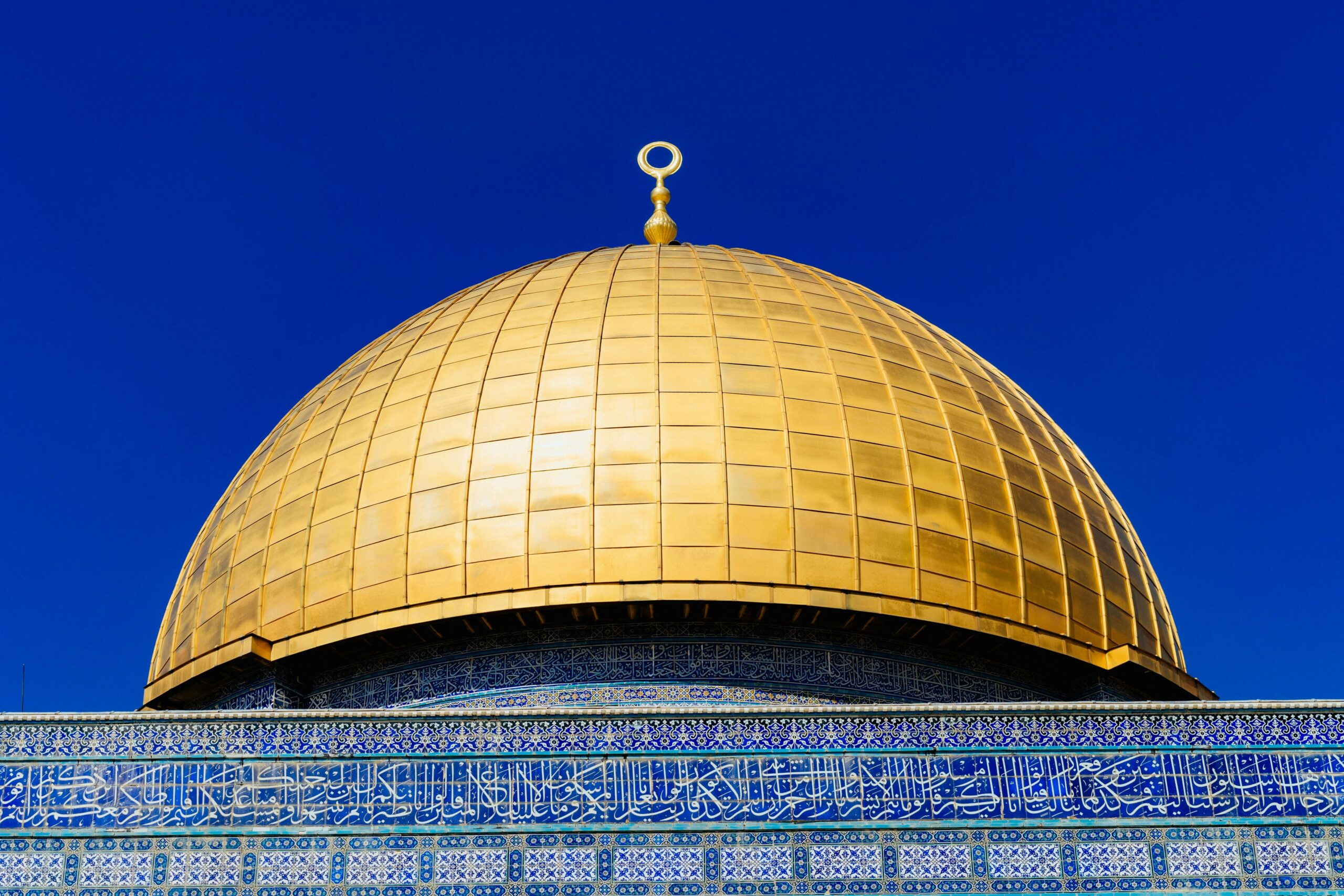
It is clear who the anti-Christ (false Christ) is; all the stories of the New Testament hyperlink to the Old Testament ones. The Dome of the Rock of Islam is currently occupying the very place where the original Temple was located, as well as the future throne of Christ.
Islam the Anti-Christ
John of Damascus, who lived under Muslim rule in the seventh century, delivered an incredibly accurate understanding of the false Christology of Muhammad. “He says that the Christ is not the Word of God and His Spirit, but a creature and a servant…Christ himself was not crucified, he says, nor did He die, for God, out of His love for Him, took Him to Himself into heaven.”2 The Bible identifies who the anti-Christ is: “Who is the liar but the one who denies that Jesus is the Christ? This is the anti-Christ, the one who denies the Father and the Son.” (1 John 2:22). This is clarified even more: “For many deceivers have gone out into the world, those who do not acknowledge Jesus Christ as coming in the flesh. This is the deceiver and the anti-Christ.” (2 John 1:7).
All of Islam denies that Jesus is God in the flesh, and they deny that he was crucified and raised on the third day. This has been the consistent teaching from the seventh century to the present times. The Qur’an denies Jesus’ deity and only views him as just a prophet, no different than those in the past: “The Messiah, son of Mary, was only a messenger; messengers before him had indeed passed away.” (Qur’an 5:75).
Muslim.org, translated into English from Arabic, reveals Islam’s anti-Christ position on Jesus:
“The Holy Qur’an emphatically proves that Jesus has passed away like other mortal human beings and is no longer alive anywhere. It clearly states that Jesus possessed only human characteristics and was in no way divine but a servant of God and His messenger. From birth to death, he was subject to all the physical and biological limitations that God has ordained for human beings.”
The summary of the Muslim.org website on Jesus states, “Hence it is fully and conclusively proved that Jesus died long ago, and belief in his continued life is against the clearest teachings of the Holy Qur’an.”
Eschatology (End Time view) of Islam
Due to the false Christology of Islam, the eschatology of the Muslim world views America and Israel as being the anti-Christ. A journal entitled “The Anti-Christ and the End of Time in Christ and Muslim Eschatological Literature” cited the consensus view of the Muslim world as stated by Sa’id Ayyub, who said, “History bears witness that the United States of America, which is completely consumed by the teaching about the anti-Christ, is now the primary enemy of Islam in every place.”
What may be shocking to the Western world is the reality that Islam, as a whole, views Israel and the West as being the anti-Christ. Where the two worldviews collide into global violence is identified in a journal article on this topic. “What is necessary for the fulfillment of dispensational Christian belief, on the one hand, is exactly what is most painful for Muslims on the other.”3
Ironically, the first reaction to the Qur’an by Orthodox Christianity was John of Damascus, who viewed Islam as being the forerunner of the anti-Christ. The earliest interplay between Islam and Christianity is recorded in the story of John of Damascus (ca. 655-750), also known as John of Damascene. John of Damascus (John Mansour) is considered one of the last of the Greek Fathers.
John Mansour was born under Muslim rule in Damascus, Syria. There, he worked for the caliph, as did his father, and he became a monk. John of Damascus lived during the Arab conquest of the Byzantine Empire; this affected his life as well as that of the Eastern Church and marked the end of the Byzantine Empire, replacing it with the Arab Empire.
Historically, the Muslim conquest began upon the death of Muhammad; in the Muslim conquest, they demanded conversion, death, or taxes for the conquered. Pagans were required to convert or die; Jews and Christians were allowed to keep their religions but were required to pay tribute and refrain from proselytizing or public religious display.
Heresy of the Ishmaelites
John of Damascene wrote an important work, “Heresy of the Ishmaelites.” He challenges Islam and carefully makes critical arguments defending the Christian faith from the false teachings of Islam. A small sampling of his work lays out the arguments with John identifying Islam as a forerunner to the anti-Christ: “Ishmaelites which to this day prevails and keeps people in error, being a forerunner of the Antichrist…”
Three very important observations: historically, he connects Islam with the two half-brothers, Ishmael and Jacob. Secondly, he identifies Ishmael with their past pagan idolatry: “These used to be idolaters and worshiped the morning star and Aphrodite…” Thirdly, Muhammad forged his religion from a false teacher who was an Arian Monk: “From that time to the present, a false prophet named Mohammed has appeared in their midst. This man, after having chanced upon the Old and New Testaments and likewise, it seems, having conversed with an Arian monk, devised his own heresy.” His defense is built around the idea that Islam, for all purposes, was rooted in the heresy of Arius, which was refuted in the early church councils of Nicaea. John’s work is relevant today because it demonstrated that Orthodox Christianity had an answer to Islam at its outset.
Erroneous Beliefs
When you see Reformed theology deny Israel is God’s chosen people, when you see college students yell “from the river to the sea…” you begin to understand, it is all about who is the promised son, and who is the anti-(false) one.
Reformed theology’s supersessionist belief that the Church has replaced Israel in God’s covenantal plan is challenged by biblical and theological arguments emphasizing God’s promises to ethnic Israel remain irrevocable (Romans 11:29). Critics argue true believers in Christ—Jew and Gentile alike—are grafted into Israel, not a new entity standing in its place. Supersessionism often downplays or spiritualizes Old Testament covenants (land, promises to David), treating them as fulfilled only typologically rather than continuing concrete promises. This approach, say critics, undermines God’s faithfulness to Israel and risks marginalizing Jewish identity and Scripture’s historical grounding, posing ethical and hermeneutical problems for understanding God’s global redemptive plan.
On limited atonement, Reformed theology claims Christ died only for the elect, an efficacious atonement secured exclusively by divine decree—not for the entire human race. However, opponents highlight numerous passages stating Christ’s death was for “the sins of the whole world” (1 John 2:2), “world” (John 1:29; 12:32), and “whosoever believes” (Romans 10:13). They also argue the logic of limited atonement makes Christ’s sacrifice only a partial solution—contradicting the biblical witness to the sufficiency of His death. Critics contend Reformed defenders beg the question by reading limitation into texts through their presuppositions rather than from exegetical grounds. Ultimately, these critiques propose that Christ’s atonement is universal in scope—even if only applied to those who believe—upholding both Scripture’s global language and the doctrine of a sufficient, satisfying sacrifice for all. There is an important connection, as Islam rises in power during the end times, the reformed position of limited atonement will appease Islamic rule, as they do not believe in the necessity of proselytizing because of their position that only the elect will be saved; people do not choose salvation. Furthermore, the belief is that the church replaced Israel and has no divine right to the promised land.
Conclusion
The moment is upon us—end times are unfolding—as Israel has returned to its land, fulfilling biblical prophecy, while Islam emerges as the antichrist through its denial of Christ’s divinity, crucifixion, and resurrection; John of Damascus, writing in the mid-700s, explicitly labeled Islam the “heresy of the Ishmaelites” and a “forerunner of the Antichrist,” grounded in the lineage of Ishmael versus Jacob, underscoring a spiritual and ethnic collision that signals the last days Meanwhile, Reformed theology’s dismissal of ethnic Israel as permanently chosen and its embrace of limited atonement are false teachings: the former erases God’s enduring covenant with the Jewish people, and the latter denies Christ’s universal atoning sacrifice—both amount to spiritual deceptions that align with the very kind of apostasy prophesied to mark the end times now upon us.
1 Robert Spencer, The Politically Incorrect Guide to Islam (and the Crusades), (Washington, DC: Regnery Publishing, 2005), 19.
2 St. John of Damascus, Heresies, lines 100-109.
3 Yvonne Yazbeck Haddad and Jane I. Smith. “The Anti-Christ and the end of time in Christian and Muslim eschatological literature,” Muslim World 100, no. 4 (October 1, 2010): 506. ATLASerials, Religion Collection, EBSCOhost.